First Principles of the Web
Graphs are not the thing, they are the thing that gets us to the thing
DRAFT 0.1 · atomgraph.com · GitHub · X
Preface
The claim: there is exactly one way to build applications that are of the web rather than merely on it, and it is data-centric, declarative, and graph-based. “Exactly one” is meant relative to rules the web itself imposes — the book derives the rules, and shows what rejecting each one costs. Everything else — the JSON APIs, the JavaScript frameworks, the compile-to-browser toolchains — gets scored against those rules in Part IV. The book’s finding, stated here and argued there: each is a partial rediscovery of this way or a detour from it.
The book is structured as a derivation. Every statement in it is one of three things: a definition quoted from the web’s own specifications, a proposition that follows from previous statements, or an observation you can verify against deployed reality. If you find a statement that is none of the three, the book has a bug, and I would like a report. One statement is a deliberate exception, flagged where it stands: a single bridge from the web to the formalism (Chapter 5), argued but never proved. Disagreement with the whole belongs there. The arc runs in six parts: the object fixed, the analysis run, the result revealed as standards decades old, the industry audited, the synthesis built, the future read off. The method itself is Chapter 2’s subject; notation and reading tracks are in Appendix A.
Underneath the method is a choice of genre. The web is mostly treated as software engineering — a craft of frameworks and taste; this book treats it as a science, an object whose forced structure can be derived, proved, and tested by prediction rather than surveyed and preferred. Chapter 20 returns to it once the scores are in.
One more thing. This book is built to practice what it derives. Its canonical edition is designed as an application of that very kind, in which every proposition is a resource with its own address. That makes the edition an instance of the book’s own thesis. As of this writing, that edition is under construction: a promise the book has yet to keep.
The Argument in One Page
A web application is two functions. read turns a request and the state of the world into a document; write turns a request and a state into a new state. That is HTTP restated, and every framework ever shipped is an implementation detail of it.
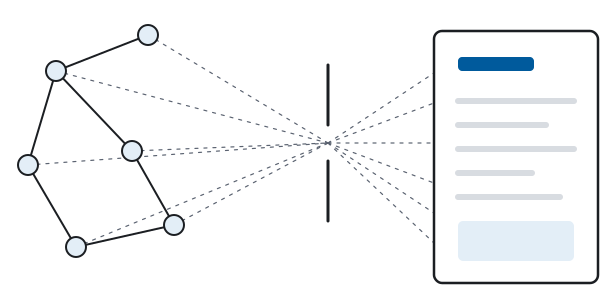
Strip any page — a newspaper, a dashboard — and the same skeleton emerges: style peels off, then arrangement, then selection, and what remains is state. So every read factors as present ∘ arrange ∘ select — one factor per stripped layer — and the factorization matters exactly when the factors are separate, declarative, substitutable, and addressable.
Ask what State must be, and the requirements come from the web itself. State must host any domain. It must compose across parties who have never met — which forces merging by union over facts that carry their own meaning. Its names must work globally. The smallest fact meeting all three requirements is a triple: two global names and a value that may itself be such a name. Any minimal model meeting the requirements is isomorphic to sets of triples under union. The uniqueness is a theorem; to reject its conclusion you must fault a step of the proof or reject a requirement.
The reveal: the structure just derived is RDF, SPARQL, XSLT, and CSS — standardized between 1996 and 2014, then abandoned; abandoned, the book will argue, not refuted. The audit: everything the industry runs instead fails a named requirement and pays for the failure with a compensating industry — a market that sells the bridge across the gap the failure opens. By the audit’s last chapter, one table carries every score — and the derived stack, scored last on the same rows, fails nothing. The synthesis: the derived parts compose into a complete architecture — no new standard needed, one generic engine specialized by data rather than code. The bill: software agents now need exactly the property the industry never adopted — machine-consumable state — and the compensating machinery is assembling in real time, at industry scale.
If the derivation holds, the next web needs no inventing; it waits to be occupied. The rest of this book is the proof, the scores, and the evidence.