Chapter 19. Generic Software
This chapter converts the derivation into economics. A one-line corollary collapses every domain application into one generic engine specialized by data; the browser and the spreadsheet are the existence proofs. The consequences follow: domain functionality shipped as data, computation arriving through the same write. The chapter closes on the incentives that keep bespoke code in place despite them.
Specialized by data
Start from a corollary the apparatus yields at once:
Prop. 19.1. Two proper applications over (5.3) differ only in their terms and their state.
Proof — S2 plus Theorem 5.4 leave nothing else to vary.
By S2, each factor is the denotation of a term; by Theorem 5.4, the state model is shared. What remains to vary is (q, t, s) and the facts. ∎
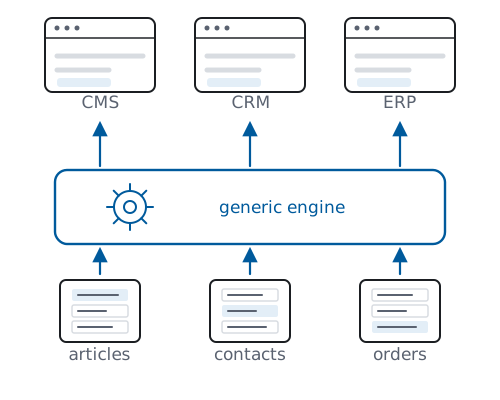
The consequence: the difference between a CMS, a CRM, and an ERP is data. Each is a UI layer around CRUD over a domain model. The domain model is facts (5.3), and the UI is ⟦t⟧ and ⟦s⟧. CRUD is read and write — Definition 1.1 and Prop. 7.1, which HTTP already implements. One application can serve every domain, specialized by data rather than by code.
Two proofs and a failure
The web has already run this experiment once, and the result was so successful it became invisible: the browser. One client for every website — nobody writes a per-site browser, and nobody marvels at that, which measures how completely the uniform interface won at the document layer. Chapter 4 typed the four clauses that won it, and generic software is their result, arriving layer by layer: generic caches, generic crawlers, one generic renderer. The result stopped where the uniformity stopped. Behind every GET the verbs are shared and the state is bespoke, so the client that is generic in transfer stays bespoke in understanding — one adapter per API, the arithmetic Chapter 22 will total. The question this chapter answers is why the generic browser never got its sibling one level down, and the answer is that nothing was missing except the state model Chapter 5 derived.
The claim has a second existence proof, older than the web. The spreadsheet is the most successful generic application in history: one engine, every domain there is, specialized by data. No vendor ships an accounting spreadsheet and a separate logistics spreadsheet; users pour the domain in as rows and formulas. The industry has had half a century to notice what this proves. The spreadsheet’s own limits explain why it could prove no more: cell references are sheet-local (R3), two workbooks have no merge (R2), and the world’s operational data lives in a million silos named final_v2.xlsx. The derived stack is the spreadsheet’s economics with the web’s properties — the same generic engine, with names that cross files and states that compose. Each proof carries half the claim: the browser is generic with the web’s properties, at the document grain; the spreadsheet is generic over domains, with none of the web’s properties. The application this chapter describes holds both halves at once — generic over domains, with the web’s properties — and it was sitting in the standards all along.
The idea has also failed before, and the failure instructs. Model-driven architecture (MDA) promised applications generated from models, and broke on its own compiler. The model was translated into code, the code drifted from the model, and the model retired into documentation — S2 severed at the first generation step. The generic engine makes no such translation. The ontology is never compiled into the application; it is the application’s data, interpreted at runtime like everything else, so nothing drifts because nothing is copied. The difference between generation and interpretation is the difference between MDA’s failure and Chapter 17’s build log.
A codebase is a liability
The economics follow. A codebase is a liability, not an asset: behavior held equal, every line is another place to be wrong. So the system achieving equal behavior with less code is the better system, and the generic system achieves it with no domain code at all. Domain functionality becomes a declarative package: an ontology and a stylesheet pair, imported into a running application. Installation is not a deployment but a merge: the package is data, so adding it is a union, and removing it is a delta — it uninstalls the way it installed. And the pair carries its own correctness check. By B.8’s relativization result, the stylesheet may treat specially only the names the ontology and its imports declare: what it touches stays inside the declared vocabulary, checkable from the term alone. So a package either declares the vocabulary it renders, or it is caught rendering vocabulary it never declared. Chapter 12 audited the binary-delivery web; this is its constructive alternative: behavior defined by data, shipped as data, revocable as data.
The reference implementation ships exactly this: applications as importable datasets, administered by an application defined in the same terms it administers. Chapter 18’s exhibit rebuilds a newspaper and a dashboard on one machine. This chapter’s claim is that the rebuild generalizes: the two reconstructions are datasets for the same generic engine, and the book’s online edition is a third.
In the world. Enterprise architecture reached this chapter’s conclusion from the cost side, without deriving it. Dave McComb’s Software Wasteland (2018) is a book-length audit of the application-centric mindset — every enterprise rebuilding the same CRUD over its own bespoke model. Its sequel The Data-Centric Revolution (2019) prescribes the data-centric cure this chapter derives: make the data the fixed point and let one generic substrate be specialized by an evolving model, not by code. Those books argue it from decades of enterprise waste; Proposition 19.1 states the same result as a corollary.
In the world, dated 2017. The liability has a mainstream witness. James Somers’s Atlantic essay “The Coming Software Apocalypse” surveys what code grown past comprehension already costs. A statewide 911 outage traced to one counter’s threshold; a runaway Toyota whose throttle code eighteen months of expert review barely untangled. A car now carries a hundred million lines. Unmoored from anything physical, software “tends to grow without bound” — into systems, as Nancy Leveson writes, “beyond our ability to intellectually manage.” The remedy one interviewee states is this chapter’s: “Nobody would build a car by hand.”
Computation on the write side
One objection lands here with real force, and it deserves the treatment latency got in Chapter 7: real domains compute. A payroll run turns timesheets into pay; an allocation turns orders into reservations; an invoice’s total is nobody’s keystroke. If the engine houses no domain code, who computes? Definition 1.1 answered before the question arose: it types what the application is — read and write — and says nothing about who calls it. Chapter 7’s caller was a human holding a form. A computation is another caller: an agent that reads, computes, and submits its conclusion through the same write, in the same normal form, reviewable and invertible like every delta. Chapter 22 turns exactly that reviewability into the governance story.
The derivation step even has a declarative carrier on the shelf. Take Prop. 7.3’s change direction — pattern plus bindings yields a delta — and draw the bindings from the state instead of a form: that is a rule, assert what follows from what holds. The deployed stack already ships it as an update term whose delta is computed by its own query. One algebra, both directions, no human in the loop.
What lacks a recommendation is when such a term runs — schedule, trigger, threshold. That is the orchestration seam, open like identity and access in Chapter 18, and like them awaiting convention rather than invention.
So the domain’s logic divides cleanly. Validation is a predicate on deltas (Chapter 7 drew that line). Derivation is an update term over the ontology. That places inference precisely: an entailed fact enters by that write, not by a closure computed at read time, so the state remains the asserted set. And whatever imperative computation remains — the solver, the optimizer, Chapter 12’s leaf — runs behind a caller, submitting deltas like everyone else: outside the engine, never inside it.
The incentives
Why, then, does every domain still get its own codebase? Chapter 13 supplied the mental models; the incentives supply the motive. Generic software commoditizes its vendor: a domain application’s defense is precisely its bespoke code, and an industry that charges rent on that code will not derive this corollary on its own initiative. The corollary dissolves the asset. So the corollary’s adoption path runs through the demand side, and Chapter 22 names the demand: users never counted the cost of bespoke code; agents count it per call.